
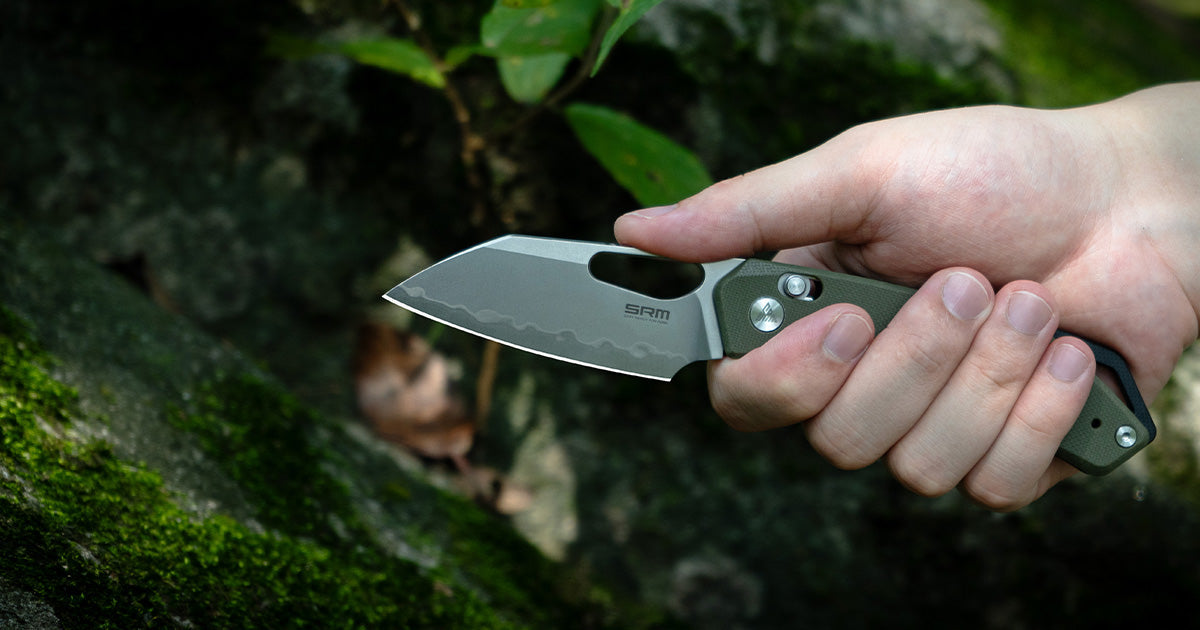
In high-end folding knives, steel quality is paramount. SRM Knives’ laminated 140Cr steel is designed for enthusiasts who want both peak performance and striking aesthetics. Unlike a single-steel blade, this material uses a three-layer “sandwich” construction. At the center is a 140Cr14MoV3Nb core, a high-carbon alloy heat-treated to HRC 59-61. This hard core provides exceptional edge retention and “hair-popping” sharpness. It is clad in two layers of tougher stainless steel, which adds corrosion resistance and toughness. The result is a blade that can match premium steels: in fact, SRM notes that the laminated 140Cr achieves a balance of hardness and edge-holding comparable to CPM‑S35VN.

The 3-Layer "Sandwich" Construction
This blade isn’t a single slab of metal. Instead, it’s constructed like a modern San Mai: hard steel in the middle, tough cladding on the outside. The 140Cr core (59–61 HRC) is a carbon-rich stainless steel. SRM lists its typical hardness at HRC 59-61, which allows a very fine, long-lasting edge. The outer layers are stainless steel (softer, more ductile) that protect the core. By laminating these metals, SRM blades gain the toughness and rust resistance of stainless steel without sacrificing edge hardness. As one SRM product description explains, “This Laminated 140Cr Steel provides comparable characteristics to S35VN… including a balance of hardness, toughness, and edge retention.” Likewise, KnifeCenter notes that laminated 140Cr offers “an excellent balance of toughness, edge retention, and corrosion resistance,” rivaling S35VN performance.
Because of this design, SRM’s laminated blades handle demanding tasks reliably. The hard core means the blade stays sharp through cutting and slicing, while the soft jacket helps absorb impacts (preventing chipping) and resists rust in harsh environments. In short, you get durability and sharpness in one.

Unique Laminated Blade Patterns
A signature feature of SRM’s laminated 140Cr knives is the organic pattern on the blade. These visible lines are simply the boundaries where the different steel layers meet, revealed by grinding. They are not laser-etched or decorative engravings – they are the real “fingerprint” of the steel. Because the layered steels bond unevenly and are ground at slightly different rates, the final pattern is entirely random. As SRM explains, “the resulting pattern is entirely random and unique”, making each knife one-of-a-kind. This means no two SRM laminated blades look alike; collectors prize them for this natural variation. The random flow of metal yields beautiful wavy lines, showcasing the 3D art of metallurgy.
Blade Care Tip: These patterns don’t affect performance, but because the core is high-carbon, it’s wise to wipe the blade dry after use. The stainless outer layers add corrosion resistance, but routine care (cleaning and oiling) will keep the knife like new.
Performance and Use Cases
SRM’s laminated 140Cr steel is tailored for users who want high performance without high cost. Its edge retention and toughness are on par with premium alloys. In practical terms, owners report that well-heat-treated laminated 140Cr can handle hard cutting tasks impressively. For example, one tester noted that “140Cr material can rival CPM-S35VN” after field tests cutting metal and cardboard. At HRC 59-61, it’s harder than many budget steels, meaning it holds an edge comparable to expensive steels. However, unlike some ultra-high-end steels, it’s easier to sharpen and more affordable.
These qualities make SRM laminated blades excellent for EDC and outdoor use: they stay sharp through chores, resist rust in rain or snow, and have the dependability needed for hunting or survival situations. They are not museum pieces – they are built to work. As SRM advises collectors, appreciate the “organic aesthetic of natural metal flow” if you value a unique look. But if you prefer a plain blade, consider SRM’s non-laminated steels (14C28N, D2, etc.).
Key Advantages of SRM Laminated 140Cr Steel:
- Hard, durable core: High edge retention and fine sharpness (HRC 59-61).
- Corrosion resistance: Stainless cladding protects against rust.
- Toughness: The layered construction absorbs impacts, reducing chips or fractures.
- Unique visuals: Each blade’s pattern is naturally one-of-a-kind.
- Value: Comparable to S35VN in performance but at a lower price point.
Technical Specifications (Typical)
- Blade Steel: Laminated 140Cr14MoV3Nb (3 layers)
- Core Hardness: HRC 59-61
- Blade Finish: [e.g., Bead Blast or Coated, depending on model]
- Use: All-purpose EDC/hunting blade
Choosing SRM 140Cr vs Other Steels
If you’re comparing SRM’s laminated steel to a single-steel blade, consider these points: a pure high-carbon blade (like carbon steel) might rust easily, whereas laminating it with stainless layers greatly improves corrosion resistance. Conversely, a fully stainless blade (like 154CM) may not achieve the same hardness. SRM’s approach is a compromise: it gives carbon-steel performance with stainless benefits. In SRM’s Blade Steels Guide, laminated 140Cr is rated with top marks for edge retention and corrosion resistance, reflecting its hybrid nature.
Maintenance and Warranty
- Sharpening: The laminated 140Cr core sharpens similarly to other hard steels. Use a fine stone to maintain the “hair-popping” edge. The softer stainless layer may wear down faster than the core, but this is normal.
- Cleaning: Wipe after use. The cladding resists rust, but avoid prolonged exposure to saltwater or acidic materials.
- Warranty: SRM’s standard warranty covers factory defects. Note that random blade patterns are by design; we do not accept returns based on pattern preference. Embrace the randomness – it’s what makes each SRM knife unique.
Frequently Asked Questions
What is laminated 140Cr steel, and how is it made?
Laminated 140Cr steel is a three-layer blade material used by SRM. It consists of a high-carbon 140Cr14MoV3Nb steel core (heat-treated to HRC 59-61) sandwiched between two stainless steel outer layers. This “sandwich” construction combines the hard edge-retaining core with tough, corrosion-resistant cladding. The result is a blade with outstanding edge retention and rust resistance.
How does SRM laminated 140Cr steel compare to CPM‑S35VN or other premium steels?
SRM’s laminated 140Cr performs very well for its price. SRM reports it has “comparable characteristics to S35VN steel” – meaning it balances hardness, toughness, and edge retention. In practical terms, a laminated 140Cr blade can hold an edge similar to S35VN, thanks to its 59-61 HRC core. One reviewer even found that its cutting ability rivals CPM‑S35VN after testing. However, unlike S35VN (a powdered stainless steel), the 140Cr core is not fully stainless. The stainless cladding mitigates this by protecting against rust. Overall, laminated 140Cr offers high performance comparable to premium steels but at a lower cost.
Why do SRM laminated 140Cr knives have visible layers or patterns on the blade?
The patterns on a laminated 140Cr blade are natural boundaries between the different steel layers. During manufacturing, the hard core and soft cladding are forged together. When the blade is ground and polished, the layers appear as visible lines or waves. These are not laser-etched or decorative engravings – they are the real grain of the steel. Because the bonding and grinding are not perfectly uniform, each blade’s pattern is completely random and unique. This means every SRM 140Cr blade has its own “fingerprint.”
Is laminated 140Cr steel corrosion-resistant, and how should I maintain it?
The stainless cladding on a laminated 140Cr blade greatly improves corrosion resistance. In fact, SRM notes that the laminated design “provides enhanced corrosion resistance” compared to the core alone. This makes the blade much less prone to rust than an uncoated carbon steel. However, it’s still wise to care for the knife: wipe it clean and dry after use, especially in saltwater or humid conditions. Periodic oiling helps prevent any corrosion on the exposed steel. Overall, with proper maintenance, a laminated 140Cr blade will stay rust-free under normal use.
What are the advantages of a 3-layer laminated blade versus a single-steel blade?
A 3-layer laminated blade combines the best of two worlds. The advantages include: hard core for excellent edge retention (the 140Cr core can reach ~HRC 59-61), tough outer layers for durability and shock absorption, and stainless cladding for improved rust resistance. Compared to a single steel blade, laminated blades often have better balance between toughness and hardness. They also offer unique aesthetics, since each laminated blade has its own pattern. On the downside, laminated blades can be slightly more complex to manufacture. However, for the user, they usually mean a harder-to-chip, longer-lasting edge that is still reasonably easy to sharpen.